We use enterprise level encryption and 256-bit SSL.
Cookies
We use cookies to enhance your shopping experience
It's our joy to serve over 2 million UK customers in their life's adventure.
Here's what our customers have to say
Accepted Payment Methods
PayPal
Visa
Mastercard
We Keep Your Information Secure
We use enterprise level encryption and 256-bit SSL.
Cookies
We use cookies to enhance your shopping experience
What is Christingle? Meaning, History & How to Make One (2025 Guide) | Eden Blog
What is Christingle?
Discover the Christingle meaning and symbolism. Learn the history of the Moravian Church tradition, its link to The Children's Society, and follow our 8-step guide on how to make one.
By Laura White – Eden Children's Resources Specialist
For many, it’s the Christmas service of the year. An opportunity to bring together family members of all ages, invite neighbours and friends and enjoy an hour or so of festive cheer, perhaps a mince pie (or two) and be reminded of the story of Christmas once again through the interactive Christingle service. We have plenty of Christingle Resources to help you.
The History of the Christingle
The Christingle tradition began in 1747 in a Moravian Church in Germany by Bishop Johannes de Watteville. He gave each child in his congregation a small candle wrapped in a red ribbon to symbolise Jesus as the Light of the World, and the red ribbon symbolising the blood of Christ.
During the final prayer of the service, de Watteville apparently spoke the words “Lord Jesus, kindle a flame in these children’s hearts, that theirs like Thine may become,” which made the symbolism of his gifts to the children clear.
Following the first service, the Christingle became an annual custom of the Moravian Church, even today.. However, the Christingle tradition was adapted in the British Moravian Church, which is how the Christingle received its new, modern look, consisting of an orange, a candle, and sweets on cocktail sticks.
The UK Church and Christingle
The UK-based charity, The Children's Society popularised the Christingle service in the UK. The service is now celebrated across churches and denominations across the UK from mid November all the way through to Candlemass in January.
But what does each element of the Christingle mean? And how can you lead a Christingle service in your church?
The 8 steps to a Christingle service
Gather together - you might want to set up “stations” to work at and create the Christingles, less formal seating is helpful for this kind of service.
Wash hands
Sing some songs - the louder the better
Talk about what each element means - this is a great opportunity to get everyone involved by asking them what they think they symbolise:
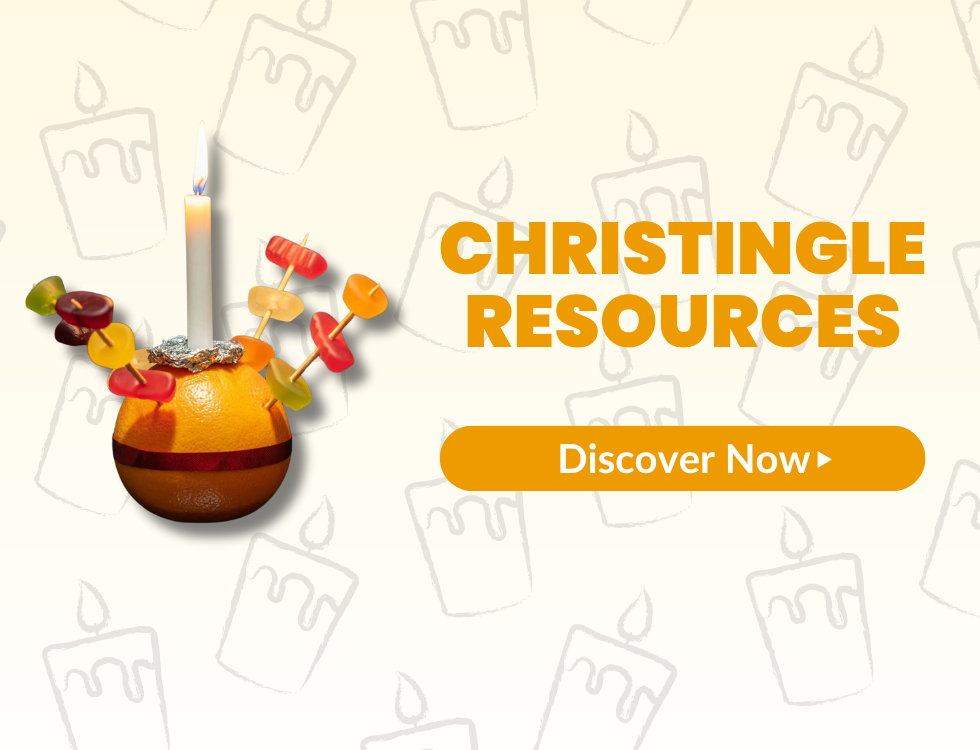
The Orange - is round and represents the world ' Related Scripture: For God so lovs the world...' - John 3:16 Cocktails sticks - Point North, South, East and West and also represent the four seasons. Related Scripture: 'God saw all that he had made, and it was very good.' - Genesis 1:31 Fruit or sweets - Represent the ‘fruits of the earth’ and God’s creation. Related Scripture: Every good and perfect gift is from above' - James 1:17 Red ribbon - the ribbon goes all around ‘the world’ and is a symbol of the blood of Jesus, shed for us when he died. Related Scripture: 'and the blood of Jesus, his Song, purifies us from all sin' - John 1:7 Candle - the candle stands tall and represents that Jesus is the light of the world. Related Scripture: 'I am the Light of the World' - John 8:12
Make the Christingles
Light the Christingles - Make sure everyone is aware of health and safety and keep an eye out for little hands that like to grab! Drip shields are great for avoiding hot wax on skin!
Pray together and maybe sing a quiet song
Spend time together - after the service why not use this as an opportunity for fellowship? Perhaps everyone could stay and enjoy a meal together or just hot drinks and festive treats. You might want to serve some mulled wine! Whatever you decide enjoy the time with friends old and new.
Important Safety tips:
1. Wash your hands before handling and sweets, have hand sanitiser available for use before and after assembling the edible parts.
2. Supervise children closely - especially around sharp knives, lit candles and sharp skewers. Ensure this is reitterated to parents and guardians throughout the service and have volunteers on hand. 3. Secure candles securely - Use drip shields around the candle and foil to secure within the orange. 4. Keep loose clothing, like scarves away from fire - encourage loose items to be removed and long hair to be tied back.
5. Keep the Christingle upright, especially once lit. Encourage participants to stay still whilst holding a lit Christingle. 6. Never leave lit Christingles and candles unattented - if concerned use LED or battery-operated candles. 7. Be mindful of choking hazards - Choose larger sweets, ensure children are sat down whilst eating.
The Christingle is a joyful symbol of God's love and Jesus' sacrifice. It's perfect for sharing with families and your local community throughout Advent.
Looking for more resources for your Christingle? We’ve got your supplies sorted here.
Wondering what 9-point or 12-point font actually looks like? Use our visual Bible font size comparison chart to find the perfect Large, Giant, or Super Giant print.
Why read Song of Songs? Discover 7 compelling reasons to read the Bible's ancient love poem, plus the best translation recommendations for romantic poetry.
Why read Exodus? Discover 7 compelling reasons to read the Bible's ultimate liberation epic, plus the best translation recommendations for study and daily reading.
Why read Mark? Discover 7 compelling reasons to read the Bible's shortest, fastest-paced Gospel, plus the best translation recommendations for daily reading.
Why read Acts? Discover 7 compelling reasons to read the Bible's thrilling sequel on the early Church, plus the best translation recommendations for study and daily reading.


 Trustpilot