Trustpilot
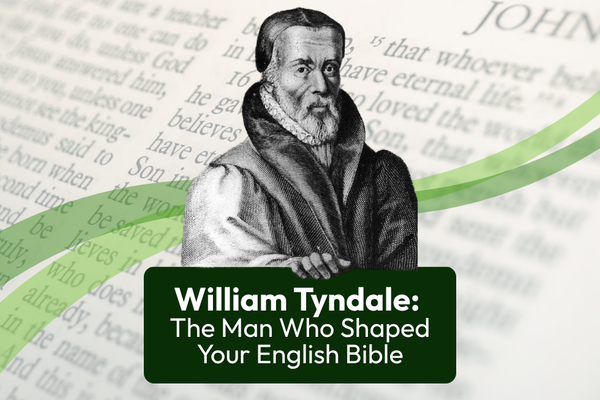
Who Was William Tyndale?
Who was William Tyndale? Discover the life, courage, and 500-year legacy of the fugitive scholar who risked everything so everyday people could read the Bible in English.
Pick up your Bible.
Flip to any page.
Notice how easily the words flow.
It is easy to take that simple gift for granted. Most of us have two or three Bibles sitting on our bookshelves, on our bedside tables, or downloaded onto our phones.
Five hundred years ago in Britain, owning those same pages in English could cost you your life.
A Country Kept in the Dark
Picture Tudor England under King Henry VIII.
Church services were held in Latin. The readings were in Latin. The prayers were in Latin.
For the average person working the land, raising a family, or running a shop, it might as well have been complete gibberish. People sat through church each Sunday listening to sounds they could not understand.
Under the law, translating even a single line of Scripture into English was treated as a crime. The Church claimed that English was too crude for holy words. They worried that ordinary people would get confused, ask questions, or wander into heresy.
Latin was the language of the altar. Latin was the language of the court. Latin was the language of power.
Ordinary folk were simply left in the dark.
One young scholar from Gloucestershire decided that had to change.
His name was William Tyndale.
In 2026, we mark the 500th anniversary of Tyndale’s printed English New Testament (1526–2026). His story is not dry, dusty history. It is a gripping real-life tale of grit, secret escapes, heartbreak, and a prayer that changed our nation forever.
1. The Boy at the Plough: A Dangerous Dream
Tyndale was born around 1494 near the Welsh border. He was sharp, curious, and remarkably gifted with languages.
He studied at Oxford. He moved on to Cambridge. Along the way, he mastered seven languages: Hebrew, Greek, Latin, Italian, Spanish, French, and English.
Yet posh academic common rooms never felt like home to him.
In his late twenties, Tyndale took a job as a live-in tutor for a wealthy family at Little Sodbury Manor in Gloucestershire. Local abbots and clergy regularly gathered around the dining table for big Sunday roasts. Tyndale sat with them. He listened to their debates.
He was stunned by what he heard. Many of these well-fed church leaders barely knew the Gospels at all.
During one heated supper debate, an annoyed cleric lost his temper:
"We were better be without God’s law than the Pope’s!"
Tyndale did not hold back. He fired back with a promise that defined the rest of his days:
"I defy the Pope and all his laws! If God spare my life, ere many years I will cause a boy that driveth the plough shall know more of the scripture than thou dost."
The ploughboy should have the Word of God.
That was his dream. And it changed everything.
2. On the Run: The 1526 Breakthrough
Tyndale travelled up to London in 1523. He asked Cuthbert Tunstall, the Bishop of London, for permission to translate the Greek New Testament into English.
Tunstall showed him the door.
Tyndale realised the harsh truth straight away:
"There was no room in my Lord of London’s palace to translate the New Testament, but also that there was no place to do it in all England."
He boarded a ship for Europe in 1524. He never saw English soil again.
Financed by friendly London cloth merchants who believed in his mission, Tyndale lived as a fugitive across Germany and the Low Countries. He moved between safe houses. He used fake names. He stayed one step ahead of spies, royal informers, and bounty hunters.
John Wycliffe had written an English Bible 140 years earlier, but Wycliffe had to copy it out by hand from a second-hand Latin translation. Tyndale did something completely brand new: he translated directly from the original Greek manuscripts compiled by Erasmus, and he used the printing press.
In early 1526, the print run was ready in the German city of Worms. Between 3,000 and 6,000 compact, pocket-sized copies of the English New Testament rolled off the presses.
How to Smuggle a Bible in Tyndale's Time
- Print in secret inside bustling river cities (for example, in Cologne, Worms, or Antwerp).
- Tuck them deep into bales of Flemish cloth, sacks of wheat, and wooden casks.
- Land on London docks right past royal customs officers.
- Pass them quietly through student groups, market stalls, and dockside inns.
- Read by candlelight in locked bedrooms, farm kitchens, and quiet barns.
Back in London, the authorities were horrified.
Bishop Tunstall rounded up hundreds of copies and burned them in huge bonfires outside St Paul’s Cathedral. Then the bishop made a massive mistake: he paid an Antwerp merchant a small fortune to buy up every copy he could find across Europe to burn them.
The punchline? The merchant was secretly friends with Tyndale.
Tunstall’s church money went straight into Tyndale’s pocket. It paid off his debts and funded brand-new, corrected print runs.
The authorities bought the books. The presses ran twice as fast.
3. The Words on Your Lips Today
Tyndale was not just an accurate scholar. He was a brilliant communicator.
In the 1520s, English was seen as a second-class language. It was bumpy, plain, and lacked the elegance of Latin or French. Shakespeare was still decades away from being born.
Tyndale took everyday spoken English and gave it music, rhythm, and dignity. He chose short, warm, Anglo-Saxon words that sounded wonderful when read aloud in a humble living room.
When he could not find an English word that matched the Hebrew or Greek, he simply invented one.
Familiar English Words Tyndale Coined:
- Passover (describing the ancient Jewish feast)
- Atonement (literally "at-one-ment", bringing people and God back together)
- Scapegoat (from the laws of Leviticus)
- Mercy seat
- Peacemaker
Phrases You Know by Heart:
- "Let there be light" (Genesis 1:3)
- "The salt of the earth" (Matthew 5:13)
- "A city that is set on a hill cannot be hid" (Matthew 5:14)
- "Ask, and it shall be given you; seek, and ye shall find; knock, and it shall be opened unto you" (Matthew 7:7)
- "The spirit is willing, but the flesh is weak" (Matthew 26:41)
- "Fight the good fight" (1 Timothy 6:12)
- "In him we live, and move, and have our being" (Acts 17:28)
- "Gave up the ghost" (Mark 15:37)
When King James I gathered 54 scholars in 1604 to produce the famous 1611 King James Version, they did not start with a blank sheet of paper. Modern analysis shows that around 84% of the King James New Testament and more than 75% of the Old Testament are drawn straight from William Tyndale.
4. The Antwerp Alley and the Stake
By 1535, Tyndale had translated the whole New Testament, Jonah, and the first five books of the Old Testament from Hebrew. He found temporary shelter in Antwerp, living safely inside a house reserved for English merchants.
Then he met Henry Phillips.
Phillips was a charming, smooth-talking young Englishman from a good family who had gambled away his father's money. He arrived in Antwerp pretending to love the Reformation. He struck up a friendship with Tyndale. He sat at his table.
It was all an act. Phillips had taken money from English enemies to betray him.
On 21 May 1535, Phillips invited Tyndale out for lunch. As they walked down a narrow alleyway, Phillips stepped behind the scholar and pointed down at his head. Imperial soldiers jumped out from the shadows.
They locked Tyndale in the damp, freezing dungeon of Vilvoorde Castle near Brussels. He spent sixteen months there.
Winter arrived. In a surviving letter written in Latin to the castle governor, Tyndale politely asked for warmer clothes—a thicker coat, a woollen cap, a pair of leggings, and a candle:
"I ask your lordship... that he would allow me to have my Hebrew Bible, Hebrew Grammar, and Hebrew Dictionary, that I might pass the time in that study."
Even shivering in the cold, he kept studying.
On 6 October 1536, soldiers led Tyndale out to the town square. They tied him to a heavy wooden stake.
Before the executioner stepped forward, Tyndale looked up and shouted his dying prayer:
"Lord! Open the King of England’s eyes!"
The hangman twisted the iron chain around his neck, strangling him. Moments later, gunpowder flared, and his body burned.
5. An Answered Prayer
God answered Tyndale’s dying cry with remarkable speed.
Just three years after the fire at Vilvoorde, King Henry VIII broke ties with Rome. He needed an English Bible for his people. In 1539, Henry issued a royal decree commissioning the Great Bible.
Every parish church in England was ordered by law to buy a large copy. Churchwardens chained it securely to a lectern. Anyone could walk through the church doors, open the pages, and read the text aloud in their own language.
What the King never publicly admitted was this: the Great Bible was built almost word-for-word on William Tyndale’s translation.
The King had hunted the translator. Now the King was publishing his work.
Tyndale's dream had come true: the ploughboy was reading the Word of God.
6. Living the Legacy in 2026
Five hundred years after those first copies were packed inside cloth bales, Tyndale’s simple heart for everyday people is still with us: God’s Word belongs to everyone.
How can you connect with his story this year?
- Hold History in Your Hands: The William Tyndale New Testament, 500th Anniversary Edition honours Tyndale’s design and text, with modern spelling, updated typesetting, and decorative elements.
- Hear the Grand Cadence: Classic translations like the KJV and ESV keep Tyndale’s dignified, poetic rhythm alive for Sunday worship.
- Catch the Ploughboy Heart: Modern translations like the New Living Translation (NLT), published by the house named in his honour (Tyndale House), continue his true mission: giving everyday readers a clear, warm text they can enjoy without tripping over old grammar.
Every page you read this week was paid for with courage, sacrifice, and prayers whispered in cold prison cells.
Next time you open your Bible with your morning brew, take a quiet moment to remember the hunted scholar in Antwerp. His passion made your Bible time possible.