Trustpilot
Advent & Christmas
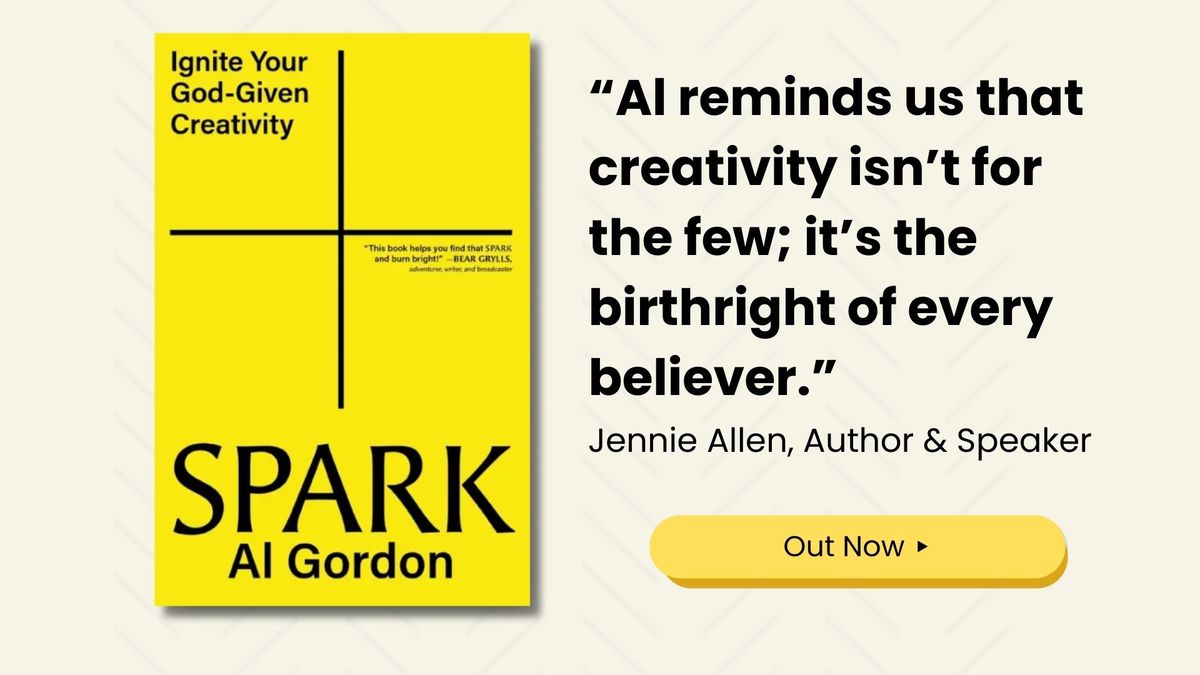
Al Gordon on Igniting Your God-Given Superpower | Author Interview
Discover how to unlock your God-given superpower. Al Gordon discusses his new book 'Spark', the "Big Lie" of non-creativity, and how to find brilliance in boredom.

By Anna Hockley – Eden Christian Books Specialist
Estimated Read Time: 4 minutes
We often treat creativity as a luxury for the gifted few, but Al Gordon—leader of SAINT and founder of Renaissance—believes it is actually the Church’s 'lost superpower.'
In his new book, Spark, Al dismantles 'the Big Lie' that some of us just aren't creative, arguing instead that we are never closer to God than when we are creating. From catastrophic failures involving angry bees to the intersection of neuroscience and prayer, Al shares how we can all ignite our God-given potential in an age of algorithms.
Can you share a defining moment in your life — perhaps a challenge or creative breakthrough — that shaped your understanding of creativity and faith? How has this gone on to impact your work and ministry today?
Most of the creative breakthroughs I’ve experienced have come as a result of catastrophic failures. In SPARK I tell a bunch of stories of when things have gone horribly wrong, from being attacked by a swarm of angry bees, to narrowly avoiding being sued by one of the tech giants, to causing mass food poisoning. Failure is a great teacher, and if we allow God to spark creativity in the midst of our challenges, then extraordinary things can follow. That’s certainly the experience of so many whose stories we hear in SPARK.
What 'sparked' the idea for writing this book, pun intended!
I really want to help you grow in your God-given superpower: your creativity. So many people dismiss ‘creativity’ as something that only Creative people (capital C intended) get to do—but the reality is that everyone is creative, because they’re made in the image of a creator. The most powerful thing you can do is learn to ignite that God-given creativity in your life.
In Spark you talk about reframing creativity, almost like a spiritual discipline.
What’s one daily practice you personally do to nurture your creative life — especially when you’re stuck or discouraged?
The good news is that there are simple, repeatable habits that you and I can learn to practice that will enhance our creativity. In SPARK we delve into how the brain works—talking to neuroscientists, world-class creatives and people who have learned how to unlock extraordinary impact—and what we find is surprising: creativity is a muscle that can be strengthened. For me, one of the key habits is allowing myself to be bored. Boredom is the birthplace of brilliance. Ideas come in the gaps. So switching off, letting my mind daydream and igniting my imagination is so often the spark that lights the fire of creativity.
You describe in the book 'the Big Lie' that many believe - "I'm not creative". Why do you think this lie takes such hold in the Church today? Are there particular cultural or spiritual barriers that make it so persistent?
One of the things that SPARK does is dismantle the big lie that you’re not creative. We say, ‘Oh that person, they’re really creative’, whilst denying our own imagination, ability to innovate and have an impact. That’s not God’s plan for your life—you’re made in the image of God the Creator—the secret is learning to unlock your God-given potential and express it through your faith, your courage and the way you love those around you. Creativity is the church’s lost super power, and this is a key moment to recover that gift.
It is said "Comparison is the thief of joy" and I think this is often something that dampens people's creativity. Have you got any practical advice on how to avoid comparing yourself to others?
This is a really key question of identity, one that we tackle front and centre in SPARK. We can learn to replace negative comparison with positive community. We are not designed to create alone—we’re made for collaboration—and God invites us into that place of security and love from which we can make an impact. When our creativity flows from God’s spark at work in us, comparison becomes irrelevant.
You say in the book "Creativity is a holy endeavour". How do you see creativity as a way to strengthen your faith?
You’re never closer to God than when you create, because creating is the serious business of heaven. In SPARK we look at how recent developments in neuroscience have identified how the same part of the brain that is responsible for prayer and spiritual experience is also the very same place that ideas, creativity and newness flow from. Your creativity is spiritual. That’s literally mind-blowing.
How did the Renaissance movement grow out of your own experiences in church - and what do you think ‘creative discipleship’ looks like in practice for a local congregation?
Renaissance—the global movement that gathers creatives, innovators and young leaders to help spark their creativity—emerged out of the pandemic as a way of encouraging people to dream again. Our big idea has been to create a space where we can all grow in our experience of God as creator, and have the courage to take risks, be brave and reshape the world. SPARK is taking all that we’ve been learning and making it accessible for people everywhere.
The book is designed to be read in a small group—what we’re calling SPARK CIRCLES—where you can work through a chapter together, then circle back around the questions at the end of each chapter. The hope is that it will help ignite the creativity of all believers, and help people grow in their faith.
We're living in a world that is increasingly turning to artificial intelligence for generating non-original content. What do you think about the role of AI and how Christians should be using it? Does it harm our creativity or are there ways we can harness it for positive change?
This is a question we dive right into in SPARK, because it’s one of the key questions of our age. What really does it mean to be human in the age of algorithms? Ai can help for sure, and it can perform many creative tasks better than us, but it lacks the spark of divine originality: that only comes from the Spirit of God working in your life. Algorithms don’t dream, they only hallucinate. So ironically while human creativity has never been more under threat, it’s also never been more urgently needed.
As a Christian bookseller I'm always keen to know - what is your favourite Christian book (other than the Bible!) and how has it influenced your faith journey?
Am I allowed three—well, it’s probably at least three because one is a series… sorry!? First, Questions of Life by Nicky Gumbel.
Nicky is a hero and mentor, and this book that is the foundation of Alpha is simply the best, simplest and most life-changing explanation of the Christian faith there is. Second, CS Lewis’ complete Chronicles of Narnia are beautiful illustrations of theology in motion, of how creativity and storytelling amplify and connect. In SPARK we uncover how Lewis would describe the ‘baptism of his imagination’ as being a key factor in his conversion. Third—and this is a bit of a wild card— Bede’s A History of the English Church and People. Written in 731AD, it’s not just one of the earliest pieces of British history, it’s packed full of extraordinary stories of the good news of Jesus impacting lives. Where else can you have stories of miracles, sea monsters and battles, but written as historical account. It’s stunning.
Now that Spark is out in the world, what’s one big vision you have for its impact? And where can people follow your work and get involved with Renaissance or SAINT?
These are days when we all need to urgently recover our courage, to imagine, dream and create a different future. My hope and prayer is that SPARK will set fire to your God-given potential, help you be brave and follow Jesus in these days. I believe we’re living in an age of renaissance, when the world will be turned upside down by those who have learned to invite the Creator Spirit to ignite their lives. So gather your friends, start a SPARK CIRCLE, encourage one another. That’s the idea at least… and I’d love to hear how you get on as well—you can keep in touch on socials @algordon.co or at algordon.co