Trustpilot
A Beginner’s Guide to the Bible: Where to Start When You Have "Zero Background"
Intimidated by the Bible? You aren't alone. Discover the difference between the Old and New Testaments, which translation is easiest to read, and why you shouldn't start on page one.
Estimated Read Time: 5 minutes
Quick Start: Where should you begin?
- The Translation: Choose the New Living Translation (NLT) or the New International Version (NIV). They translate ancient concepts into clear, modern English.
- The Starting Line: Do not start at Genesis (Page 1). Start in the New Testament with the Gospel of Mark. It is the shortest, fastest-paced biography of Jesus and the easiest way to understand the core of the Christian faith.
There is a cultural shift happening right now. Across the UK, people with absolutely no religious upbringing are suddenly walking into bookshops and buying Bibles.
If you are one of them, welcome. You are joining millions of people around the world seeking ancient wisdom in a highly anxious, digitally exhausted world.
But there is a problem. You get the book home, sit on the sofa, open it up... and realise it is a 750,000-word ancient text with tiny print, weird numbers in the text, and names you can't pronounce.
It is incredibly intimidating.
If you have "zero background" in Christianity, here is your practical roadmap to reading the Bible without getting overwhelmed, lost, or bored.
A Great Starting Bible
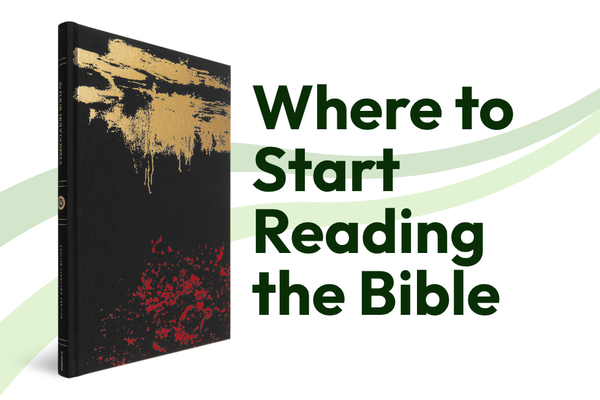
If we had to pick one Bible for beginners, it would be this NLT Wide Margin Bible. We gave this our pick for three reasons:
- The NLT Translation is an accessible, reliable translation for first-time readers.
- It has wide margins (meaning extra space at the edges of the pages) where you can make notes about passages you like or want to come back to (yes, here we encourage you to actually write in a book!).
- It comes with the free Filament App - you can scan any page and get free background information about whatever chapter you are reading. It’s a great way to help you understand what is happening on any given page of the Bible.
You can buy this Bible here.
1. The Layout: It’s a Library, Not a Novel
The biggest mistake beginners make is treating the Bible like a standard book. It isn't one book; it is a compiled library of 66 different books written over 1,500 years by dozens of authors (kings, shepherds, fishermen, and doctors).
It is divided into two main sections:
- The Old Testament (39 Books): This is everything that happened before Jesus was born. It contains the creation of the world, the history of the Jewish people, poetry, and prophecies.
- The New Testament (27 Books): This is the story of Jesus' life, his death and resurrection, and the letters written to the very first Christian churches.
2. The "Genesis Trap" (Where NOT to start)
If you treat the Bible like a novel, you will naturally start at Genesis Chapter 1.
You will actually do great for the first fifty pages. Genesis and Exodus are full of famous narrative stories (Adam and Eve, Noah's Ark, Moses parting the Red Sea).
But shortly after, you will hit the book of Leviticus. Leviticus is a detailed manual of ancient Jewish laws, dietary restrictions, and temple sacrifices. It is incredibly important historically, but it is deeply confusing for a modern beginner. This is where 90% of first-time readers quit.
3. Where to Start: Meet the Main Character
If you want to understand Christianity, you need to start by looking at Jesus. That means starting in the New Testament with the "Gospels" (the four biographies of Jesus).
Here are the two best starting points:
Option A: The Gospel of Mark (For Action)
- Why start here: Mark is the shortest and fastest-paced book. The author uses the word "immediately" constantly. Jesus is always on the move—healing, teaching, and challenging the corrupt leaders. You can read the whole book in about 90 minutes. It gives you the "facts" of what Jesus did.
Option B: The Gospel of John (For Depth)
- Why start here: While Mark focuses on what Jesus did, John focuses on who Jesus is. It is beautifully poetic and focuses heavily on the love of God. If you are reading the Bible to find spiritual comfort and peace, John is the perfect starting line.
4. Choosing the Right Translation
The Bible was originally written in ancient Hebrew and Greek. That means every English Bible is a translation, and some are much harder to read than others.
If you have no church background, do not buy a King James Version (KJV). The 1600s "Thees and Thous" will act as a major language barrier.
A Quick Note: Many readers without a Church background have a deep love of the King James Bible. Its poetic style and memorable wording make it a classic that would easily sit alongside the works of Shakespeare. If you’re a reader who enjoys fine writing, then the King James Version (KJV) Bible may, in fact, be the right Bible for you.
Instead, look for these two translations:
- The NLT (New Living Translation): This is a "thought-for-thought" translation. It reads smoothly, almost like a modern novel. It is universally considered the best choice for absolute beginners.
- The NIV (New International Version): The most popular modern translation in the world. It strikes a great balance between word-for-word accuracy and easy-to-read English.
Your 7-Day Starter Plan
Don't try to read for an hour a day. Start with just 10 minutes. Grab an NLT or NIV Bible, and try this one-week plan:
- Day 1: Mark Chapter 1 (The story begins)
- Day 2: Mark Chapter 2 (Jesus breaks the religious rules)
- Day 3: Mark Chapter 4 (Jesus tells stories/parables)
- Day 4: Mark Chapter 15 (The Crucifixion)
- Day 5: Mark Chapter 16 (The Resurrection)
- Day 6: Psalm 23 (A short, ancient song for when you feel anxious)
- Day 7: Proverbs 3 (Practical wisdom for daily life)
Reading the Bible is a lifelong journey. You don't need to understand every single verse on your first try. Just open to the Gospel of Mark, read a chapter, and ask yourself: "What does this tell me about God?"